点击蓝字
关注 澜沧江-湄公河综合执法安全合作中心
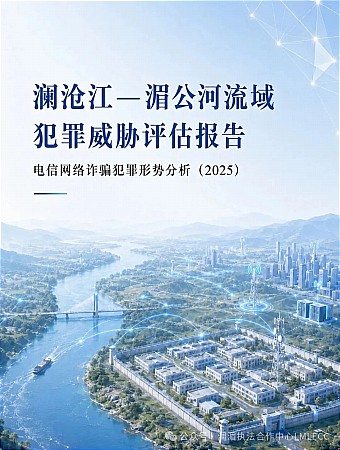
通过对人员、技术、资金三大核心要素跨境流动模式的系统分析,报告识别整个犯罪网络中的关键节点与高风险环节,并进一步评估其对区域安全与社会治理构成的风险。
1
人员流:“诱骗—贩运—囚禁—强制”
犯罪集团以高薪、低门槛和海外工作为诱饵,通过社交媒体和非法中介招募人员,再经多国转运送往犯罪园区。人员证件被收缴、与外界联系中断,并在暴力威胁下接受诈骗“培训”。
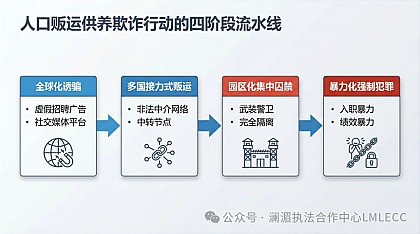
人口贩运供养欺诈行动的四阶段流水线
2
技术流:“采购—部署—应用—对抗”
犯罪集团通过暗网、专业供应商和公开市场采购通信设备、诈骗软件、虚假平台及人工智能服务,集中部署于犯罪园区。技术被嵌入目标筛选、话术生成、身份伪造和通信规避,并持续更新。
3
资金流:“诈骗—归集—清洗—再投资”
受害者资金进入银行账户或第三方支付渠道后,被迅速拆分和多层转移,再通过场外交易兑换为虚拟资产。犯罪集团利用混币、跨链转移、匿名钱包和地下承兑掩盖来源,最终兑换、消费或再投资。
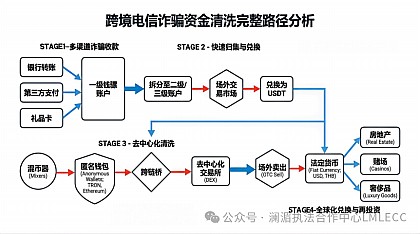
跨境电信诈骗资金清洗完整路径分析
4
风险评估:关键节点具有脆弱性
人员链涉及虚假招聘、边境管控和受害者识别;技术链涉及设备流通、平台责任和数据监管;资金链考验可疑交易监测、跨境冻结和虚拟资产追踪。关键节点失守,可能放大人口、社会和金融风险。
5
总体判断:自我演化的“犯罪有机体”
犯罪网络已演化为一个具备高度适应性、学习能力和再生能力的“犯罪有机体”。资金链是其“血液”,人员链是实施犯罪活动的“肌肉”,技术链则构成感知、决策与行动的“神经系统”。治理应优先切断资金链,同时削弱人员供给和技术赋能,破坏其整体生存条件。
下一期将研判未来主要趋势及三种情景,分析区域治理由“动态僵持”迈向“有效遏制”的条件。敬请关注。
英 文 摘 要
English Abstract
Through a systematic analysis of cross-border flow patterns involving personnel, technology, and capital, the report identifies the key nodes and high-risk links within the criminal network and assesses their implications for regional security and social governance.
1
Personnel Flow: Lure-Traffic-Detain-Coerce
Criminal groups use promises of high salaries, low entry requirements, and overseas employment to recruit through social media and illicit intermediaries. Recruits are transported through multiple jurisdictions to fraud compounds, where documents are confiscated, external contact is severed, and victims are forced under threat of violence to undergo fraud training.
The Four-Stage Assembly Line of Human Trafficking that Supports Fraud Activities
2
Technology Flow: Procure-Deploy-Apply-Counter
Communications equipment, fraudulent software, fake platforms, and AI services are procured through the dark web, specialist suppliers, and open markets before being deployed in compounds. These technologies support target selection, script generation, identity forgery, and communications evasion and are continually adapted to counter blocking measures.
3
Financial Flow: Defraud-Collect-Launder-Reinvest
Victim funds entering bank accounts or third-party payment channels are rapidly divided and layered before being converted into virtual assets through over-the-counter transactions. Mixing services, cross-chain transfers, anonymous wallets, and underground exchangers are then used to conceal origin before the proceeds are converted, spent, or reinvested.
Comprehensive Analysis of Cross-Border Money Laundering for Telecommunications and Online Fraud
4
Risk Assessment: Vulnerabilities at Critical Nodes
The personnel chain involves deceptive recruitment, border control, and victim identification; the technology chain involves equipment circulation, platform responsibility, and data governance; and the financial chain tests suspicious-transaction monitoring, cross-border freezing, and virtual-asset tracing. Failures at these nodes can amplify human, social, and financial risks.
5
Overall Assessment: A Self-Evolving Criminal Organism
The network has evolved into a self-adapting "criminal organism" with strong learning and regenerative capabilities. The financial chain functions as its blood, the personnel chain as its muscle, and the technology chain as its nervous system. Governance should prioritize severing the financial chain while weakening personnel supply and technological enablement to disrupt the conditions sustaining the system.
The next installment will assess major future trends and three possible scenarios, including the conditions required to move from dynamic standoff toward effective containment. Stay tuned.
稿件来源 | 《澜沧江-湄公河流域犯罪威胁评估报告:电信网络诈骗犯罪形势分析(2025)》
Source | Lancang-Mekong Regional Crime Threat Assessment: Analysis of Telecommunications and Online Fraud Trends (2025)
编辑 | 黄焕然、刘海瑞
Edited by | Huang Huanran, Liu Hairui
版面设计 | 林熙、韩枭一
Art and Layout by | Lin Xi, Han Xiaoyi
校对 | 谢正军、刘晓权、刘玲胜军
Proofread by | Xie Zhengjun, Liu Xiaoquan, Liu Lingshengjun
本文为《澜沧江—湄公河流域犯罪威胁评估报告:电信网络诈骗犯罪形势分析(2025)》内容摘要。完整报告详见澜沧江-湄公河综合执法安全合作中心门户网站。如需获取本系列其他专题报告,请访问澜湄执法合作中心官网“资源—智库动态”栏目查阅。
This article is an excerpt from the Lancang-Mekong Regional Crime Threat Assessment: Analysis of Telecommunications and Online Fraud Trends (2025). The full report is available on the official website of the Lancang–Mekong Integrated Law Enforcement and Security Cooperation Center. For access to other thematic reports in this series, please visit the “Resource — Think Tank Dynamics” section on the official website of the Lancang–Mekong Integrated Law Enforcement and Security Cooperation Center.
免责声明 / Disclaimer