击蓝字
关注 澜沧江-湄公河综合执法安全合作中心
本期为《澜沧江—湄公河流域犯罪威胁评估报告:电信网络诈骗犯罪形势分析(2025)》系列的收官之篇。面对电信网络诈骗及其衍生犯罪持续蔓延、手段升级的态势,单一国家、单一部门或阶段性专项行动难以奏效,区域治理亟需由以个案处置为中心的“犯罪应对”转向以结构性干预为目标的“犯罪生态治理”。
1
治理理念:由“案件打击”转向“犯罪生态治理”
犯罪治理理念的转型并不意味着弱化执法打击,而是将执法行动嵌入制度体系,与金融监管、通信监管和网络治理、人口流动管理及廉政治理协同运作,压缩跨国诈骗活动的生存空间。
2
区域协作:提升常态化与实效性
应提高涉诈账户、通信工具、技术特征和人员流动等信息交换的规范化和时效性;推动电子证据程序、鉴定报告及执法文书格式的最低限度对接;通过联络官制度和行动计划衔接,提升多国同步打击能力。
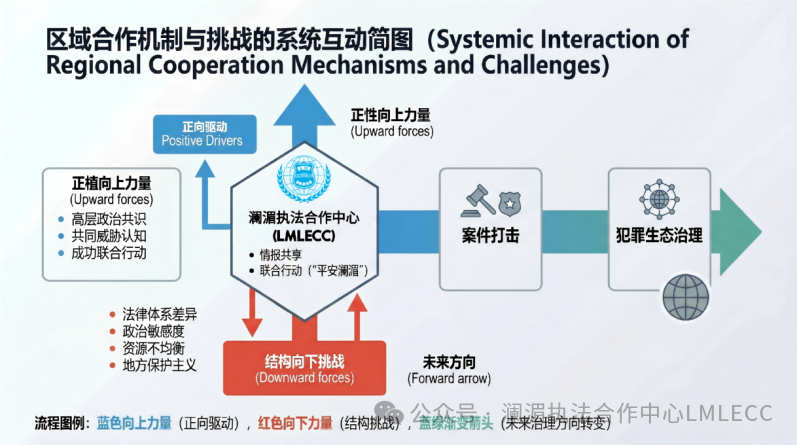
区域合作机制与挑战的系统互动简图
3
精准干预:围绕三条关键链条施策
资金链治理应强化金融情报、反洗钱和资产返还协作;人员链治理应加强虚假招聘监测、受害者甄别、保护和边境管理;技术链治理应强化虚拟货币链上追踪,压实平台、运营商和设备企业责任。
4
制度治理:压缩纵容空间、推进法律协同
各国应在尊重国家主权和国内法律框架的前提下,加强跨境取证、电子证据、嫌疑人移交的执法合作,以及执法合作和司法协助的程序衔接,并通过反腐败合作减少地方保护和治理缺位。
5
总结展望:从“动态僵持”迈向“系统治理”
产业化分工、技术升级、复合型犯罪生态及资金跨境加密化,使传统以物理国界和单一案件为中心的治理模式效能受限。要打破“高强度拉锯”与“动态僵持”,必须从被动打击转向主动治理,统筹切断资金“血液”、瓦解人员“肌肉”、压制技术“神经”、清除制度“保护伞”,提升区域安全治理韧性。
报告完结。
英 文 摘 要
English Abstract
This is the final installment in the series Lancang-Mekong Regional Crime Threat Assessment: Analysis of Telecommunication and Online Fraud Trends (2025). As telecommunications and online fraud and related crimes continue to expand and evolve, responses by a single jurisdiction, a single agency, or periodic campaigns alone are unlikely to achieve sustainable results. Regional governance must shift from incident-driven response toward criminal ecosystem governance aimed at structural intervention.
1
Governance Philosophy: From Case-Based Crackdowns to Criminal Ecosystem Governance
The transformation of the crime governance paradigm does not imply a weakening of law enforcement and enforcement actions. It embeds law enforcement action within the institutional framework and coordinates it with financial regulation, telecommunications regulation and cyber governance, population mobility management, and integrity frameworks to compress the operational space of transnational fraud.
2
Regional Collaboration: Improving Regularity and Effectiveness
Information on fraudulent accounts, communications tools, technical signatures, and personnel flows should be exchanged in a more standardized and timely manner. Minimum procedural alignment should be advanced for electronic evidence, forensic reports, and law-enforcement documents, while liaison mechanisms and operational planning should strengthen synchronized multi-country action.
Systemic Interaction of Regional Cooperation Mechanisms and Challenges
3
Precision Intervention: Targeting Three Critical Chains
Law enforcement agencies should: drive financial governance by bolstering financial intelligence, AML measures, and asset recovery cooperation; drive personnel governance by enhancing monitoring of fraudulent recruitment, as well as victim identification and protection, and border management; and drive technology governance by strengthening on-chain tracing of virtual currencies, and delineating the liabilities of platforms, telecom operators, and equipment manufacturers.
4
Institutional Governance: Reducing Tolerance and Advancing Legal Coordination
On the basis of respect for national sovereignty and domestic legal frameworks, countries should strengthen law enforcement cooperation in cross-border evidence collection, electronic evidence, and the transfer of suspects, enhance procedural coordination between law enforcement cooperation and judicial assistance, and reduce local protectionism and institutional tolerance through anti-corruption cooperation.
5
Summary and Outlook: From Dynamic Standoff to Systemic Governance
Industrialized specialization, technological upgrading, a composite criminal ecosystem, and encrypted cross-border financial flows limit governance models centered on physical national borders and individual cases. Breaking the high-intensity tug-of-war and dynamic standoff requires a shift from reactive suppression to proactive ecosystem governance, severing the supplies of funds, personnel and technology and dismantling institutional protection networks, thereby enhancing the resilience of regional security governance.
This installment marks the end of the report series.
稿件来源 | 《澜沧江—湄公河流域犯罪威胁评估报告:电信网络诈骗犯罪形势分析(2025)》
Source | Lancang-Mekong Regional Crime Threat Assessment: Analysis of Telecommunications and Online Fraud Trends (2025)
编辑 | 黄焕然、刘海瑞
Edited by | Huang Huanran, Liu Hairui
版面设计 | 林熙、韩枭一
Art and Layout by | Lin Xi, Han Xiaoyi
校对 | 谢正军、刘晓权、刘玲胜军
Proofread by | Xie Zhengjun, Liu Xiaoquan, Liu Lingshengjun
本文为《澜沧江—湄公河流域犯罪威胁评估报告:电信网络诈骗犯罪形势分析(2025)》内容摘要。完整报告详见澜沧江-湄公河综合执法安全合作中心门户网站。如需获取本系列其他专题报告,请访问澜湄执法合作中心官网“资源—智库动态”栏目查阅。
This article is an excerpt from the Lancang-Mekong Regional Crime Threat Assessment: Analysis of Telecommunications and Online Fraud Trends (2025). The full report is available on the official website of the Lancang–Mekong Integrated Law Enforcement and Security Cooperation Center. For access to other thematic reports in this series, please visit the “Resource — Think Tank Dynamics” section on the official website of the Lancang–Mekong Integrated Law Enforcement and Security Cooperation Center.